
The Mercuro Event Industry Interview Series: Sandy Carter on How Top Leaders Operationalize AI
For this edition of the Mercuro Event Industry Interview Series, I had the pleasure of speaking with Sandy Carter in a conversation that represents a bit of a departure from our typical event industry-focused content — but a very intentional one. At Genesis Exhibits, we spend a great deal of time thinking about how brands connect with people in physical spaces. But increasingly, the future of brand connection is also being shaped by artificial intelligence, digital identity, agentic systems, cybersecurity, online communities, and the ways companies operationalize emerging technology. For an industry built around engagement, trust, experience, and measurable business outcomes, these forces are no longer peripheral. They are becoming part of the larger conversation.
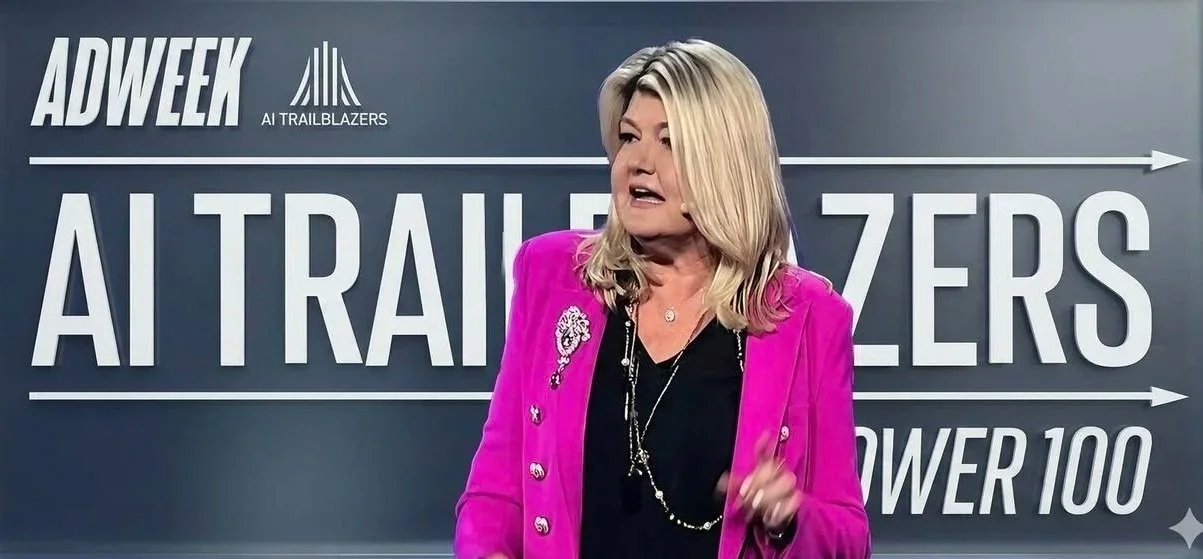
Sandy brings a rare perspective to that conversation. A globally recognized technology leader, author, speaker, and innovator, she has held senior leadership roles across IBM, Amazon Web Services, and Unstoppable Domains, and is now stepping into a CEO role in the agentic AI space. In our Q&A, Sandy does not speak about AI in abstract or overhyped terms. She focuses on what actually separates AI theater from business results: customer outcomes, adoption, ownership, workflow redesign, revenue models, executive accountability, security, and the cultural shifts required for AI to scale. Her insights offer a practical and timely look at how companies can move from experimentation to payoff — and why leaders in every industry, including events and trade shows, should be paying close attention.
AM:
Many companies say they have an AI strategy today. From your experience across IBM, AWS, and Unstoppable Domains, what separates an AI strategy that sounds good from one that actually produces business results?
SC:
Most AI strategies are really AI inventories. A list of pilots, a slide with vendor logos, a vision statement borrowed from a consulting deck. That is a wish list, not a strategy.
The ones that produce results have three things the pretty decks don't. First, a clear answer to "what gets cheaper, faster, or smarter for the customer," stated in the customer's own words. Second, a defined system of record the AI plugs into, whether that is Salesforce, SAP, ServiceNow, or proprietary data. AI without a system of record becomes a science fair. Third, a P&L owner, not just a Chief AI Officer. If no business unit leader can lose a bonus over the outcome, the strategy is decorative.
At IBM the partner programs that scaled were the ones with a measurable customer outcome attached, the ones without died on the vine no matter how good the technology was. At AWS the strategies that scaled were the ones tied directly to a customer's cost of goods sold or revenue per employee. At Unstoppable Domains our AI agent work only matters when it shortens a partner's go-to-market cycle. Numbers, names, ownership. Everything else is theater.
AM:
At what stage do most organizations fail when trying to operationalize AI, experimentation, adoption, or monetization, and why?
SC:
Adoption, by a wide margin. WalkMe and Deloitte put the number around 70 percent of AI initiatives stalling at the user layer. Experimentation is easy, every company can run a pilot. Monetization is rare because most companies never reach it. Adoption is where the bodies are.
The reason is that adoption is a behavioral problem dressed up as a technology problem. You can ship a beautiful copilot, and if the salesperson's compensation, the call center's handle time metric, or the engineer's code review process doesn't change, the tool sits unused. Humans optimize for how they are measured, not for what is announced at the all-hands.
I call the deeper version of this AI Hollowing. Companies hollow out enthusiasm before they ever hollow out skills. The fix is unglamorous. Redesign the workflow before deploying the model. Retrain the manager before retraining the employee. Tie usage to incentives within 90 days or watch the license utilization curve flatten by month four. That curve is the truest leading indicator of failure I know.
AM:
You've led AI across functions as a CPO, CMO, COO, CSO, and CBO, and you're now stepping into a CEO seat at an agentic AI company. How does AI look different from each of those vantage points, and which perspective do companies most often overlook?
SC:
Each seat sees a different animal. From the CMO chair, AI looks like personalization and content velocity. From the COO chair, throughput and error reduction. From the CPO chair, roadmap acceleration and feature differentiation. From the CSO chair, pipeline coverage and win rate. From the CBO chair, partner enablement and ecosystem leverage. From the CEO chair, and this is the shift I am living right now, AI looks like the entire operating system of the company, not a function within it.
That last view is the one most companies underweight. When AI is owned inside a function, it competes for budget with everything else that function cares about. When AI is the operating system, capital allocation, talent strategy, product architecture, and go-to-market all bend around it. The companies winning the agentic era are CEO-led on AI, with the board treating it as a category bet, not a line item.
The seat companies most often overlook beneath the CEO is the CFO. Not because finance leaders aren't smart about AI, many are, but because AI is usually presented to them as an expense line rather than a capital allocation question. The CFO who learns to underwrite an AI agent the way they underwrite a factory, with depreciation, utilization rates, and cost per transaction, unlocks budget the CIO never could.
The second most overlooked is the CHRO. Agentic workflows change job design, span of control, and career ladders. If HR is invited after the model is deployed, the organization will reject the transplant. Bring the CHRO in at the architecture phase, not the rollout phase.
AM:
What is the moment when AI shifts from being a cost center or innovation initiative into a true revenue driver?
SC:
It shifts the moment a customer pays a premium, or chooses you over a competitor, specifically because of the AI capability. Until that moment, AI is an internal efficiency story, valuable but invisible on the top line.
I watched this happen at AWS with SageMaker customers in financial services. The bank that used machine learning for fraud detection saved money, that was cost center work. The bank that turned the same model into a real-time underwriting product for small business loans grew revenue 18 percent in a year. Same technology, different business posture.
The signal I look for is what I call the third invoice. The first invoice is internal cost savings, then finance applauds. The second invoice is operational efficiency, the COO applauds. The third invoice is when a customer is billed for an AI-enabled outcome, faster claims, smarter recommendations, autonomous service. That third invoice is when AI becomes a P&L line.
For agentic companies specifically, the moment arrives when an agent transacts on a customer's behalf and you take a fee. DaVinci Commerce is doing this. OpenClaw is doing this. The economics flip the day machines start paying machines.
AM:
When launching AI-driven products or services, what business models have you seen work best, efficiency gains, new offerings, ecosystem expansion, or something else?
SC:
Ecosystem expansion wins over a five-year horizon. Efficiency gains and new offerings are necessary, and they are also the most copyable. A competitor can match a chatbot in a quarter. A competitor cannot match a network of partners, data, and agents in a quarter.
The pattern I've watched across IBM's partner ecosystem, AWS Marketplace, and now the ICANN partner work at Unstoppable Domains is the same. The companies that win build a flywheel where each new partner makes the AI smarter and each smarter model attracts more partners. NVIDIA is the obvious example. Their developer ecosystem is the moat; the chips are the surface.
For most enterprises the right starting model is hybrid. Efficiency gains fund the first 18 months and buy executive patience. New offerings prove the product roadmap can monetize. Ecosystem is the bet you place in year two with the credibility the first two earned.
One business model people undervalue is data licensing. If your AI is trained on a proprietary corpus, that corpus is itself a product. Reddit figured this out. Bloomberg figured this out. Most enterprises are sitting on training data they treat as exhaust when it should be inventory.
AM:
Since AI products often struggle not because of technology but because of positioning and adoption, what does an effective go-to-market strategy for AI look like?
SC:
The best AI go-to-market strategies sell outcomes, not models. Customers do not buy a transformer architecture, they buy fewer support tickets, faster underwriting, or higher conversion. If your sales deck spends more time on the model card than on the customer's P&L, you have an engineering pitch wearing a marketing costume.
Several things separate the AI launches that scale. The first is a named use case with a number attached. "Reduce claims processing from 14 days to 36 hours" beats "AI-powered claims intelligence" every time. The second is a champion inside the customer who owns the metric, usually a line of business leader, rarely the CIO. The third is a proof window measured in weeks, not quarters. If a buyer cannot see value inside one billing cycle, the deal dies in procurement.
For agentic products the rules tighten further. You have to demonstrate trust before you demonstrate capability. Show the audit trail, show the guardrails, show the human-in-the-loop, then show the magic. Accenture's deployment playbook with clients gets this right. They lead with governance and earn the right to lead with autonomy. That order matters.
AM:
Many companies successfully run AI pilots but fail to scale them enterprise-wide. What operational changes are required to move from pilot to production?
SC:
The pilot-to-production gap is rarely a model problem. It is an operating model problem. Pilots succeed because a passionate team controls all the variables. Production fails because the same team suddenly has to negotiate with legal, security, procurement, IT, HR, and 14 business units.
That said, there are key operational changes that consistently close the gap. First, a shared infrastructure layer for AI, one platform team that owns models, monitoring, and access, so every business unit isn't reinventing the wheel. Second, a productization function that takes the pilot's hack and rebuilds it for reliability, observability, and cost-per-call economics. Third, a change management practice with real headcount, not a SharePoint site.
This is the through-line of my SXSW 2026 keynote, "From Pilot to Payoff, 7 Things Nobody Is Telling You About AI Systems That Actually Work." The PAYOFF framework I built for that talk walks executives through the seven stages teams skip when they confuse a pilot with a product. The most commonly skipped stage is the operational redesign. Companies deploy AI on top of broken processes and wonder why the ROI evaporates. AI accelerates whatever process it touches. If the process is broken, the AI accelerates the brokenness.
One more practical move. Set a budget cap on pilots and a different budget for production. Mixing the two pools is how good ideas starve and bad ideas keep getting funded.
AM:
What metrics should executives actually use to evaluate AI success, and which commonly used metrics are misleading?
SC:
The metrics that matter are boring and specific. Cost per transaction before and after AI. Cycle time before and after AI. Customer outcome before and after AI, measured in the customer's preferred unit, dollars, days, or defects. Adoption rate by role, tracked weekly. Revenue per employee, tracked quarterly.
Here is the metric almost no one tracks and everyone should. Subtraction. What did you stop doing because of AI. Which reports got retired, which meetings got cancelled, which tools got deprecated, which headcount got redeployed to higher-value work. Most AI programs measure addition, new capabilities, new pilots, new use cases, and quietly let the old work pile up alongside. The companies generating real return are aggressively subtracting. If your AI deployment list is growing and your retirement list is empty, you are building cost, not creating leverage.
The metrics that mislead are the ones that feel good in board decks. Number of pilots launched tells you nothing about value created. Number of use cases identified is a measure of imagination, not execution. Model accuracy in isolation is meaningless if the model is not used. Hours saved is almost always overstated because it counts theoretical time, not reallocated time. If you save an analyst four hours a week and they spend those four hours on email, you saved nothing.
The single most useful metric I've seen is what I call decision velocity. How many decisions per week does the organization make with AI in the loop, and how do the outcomes of those decisions compare to the unaided baseline. Decision velocity captures adoption, quality, and impact in one number. It is harder to game than productivity, and it tracks closely with revenue six to nine months later.
One quiet warning. If your AI metrics are all positive and your customer satisfaction metrics are flat, the AI is helping you, not them. That gap closes fast in a competitive market.
AM:
What leadership or cultural shifts must happen inside an organization before AI can truly scale?
SC:
The first and most relevant is leadership comfort with public learning. AI deployments will have visible failures, hallucinations, biased outputs, and edge cases that embarrass the brand. Leaders who treat those failures as scandals rather than data will drive teams underground, and underground AI is the most dangerous kind. The companies that scale are led by executives who can say "we got that wrong, here is what we changed," on camera, without flinching.
Next up is a redefinition of expertise. For thirty years the expert was the person who knew the most. In an AI-augmented organization, the expert is the person who asks the best questions and validates the best answers. That sounds small. It rewires performance reviews, promotion criteria, hiring profiles, and compensation. Most HR systems are not ready.
Lastly, is what I describe as the AI First, Human Always posture. AI is the default starting point for any new workflow, and a human owns the judgment, the relationship, and the accountability. Organizations that put humans first and bolt AI on the side will lose to those who flip it. Organizations that put AI first and treat humans as overhead will lose their customers, their talent, and eventually their license to operate. The middle path is the only durable one.
Culture is downstream of incentives. If you want the culture to shift, change what gets rewarded on Friday, not what gets said at the offsite.
AM:
As AI-oriented cybersecurity concerns increase with news of rapid advances like Mythos, the version of Claude that can identify security gaps, how can a growing business with agentic aspirations safely navigate the future?
SC:
Mythos is a signal worth pausing on. When the same model that can find vulnerabilities in your code can also find them in your competitor's code, in your supplier's code, and in your own agent's code, the asymmetry between attackers and defenders compresses fast. Defenders who treat this as a quarterly patch cycle will lose to attackers who treat it as continuous reconnaissance.
Agentic AI changes the threat surface in three ways most security teams haven't fully internalized. Agents have credentials, agents make decisions, and agents talk to other agents. Each of those creates a new attack vector. Stolen agent credentials are worse than stolen employee credentials because agents work 24 hours a day. Compromised agent decisions can move money before a human notices. Agent-to-agent communication can be poisoned, spoofed, or hijacked at machine speed.
The companies navigating this well are doing four things. First, every agent has a verifiable identity, ideally cryptographic, ideally portable across systems. This is the work happening around .agent and .ai TLDs and the broader agent identity standards. Second, every agent has a budget and a blast radius, hard limits on what it can spend, send, or sign. Third, every agent decision is logged in a way that supports forensic review, because the question after an incident is always "what did the agent see and what did it decide." Fourth, the security team uses tools like Mythos on its own systems before an adversary does. If Claude can find your gap, assume someone else's model already has.
For a growing business specifically, my advice is to assume your first serious incident will involve an agent doing exactly what it was told, in a context no one anticipated. Design for that scenario. Build the kill switch before you build the agent. The companies that treat identity, observability, and reversibility as foundational will earn the right to scale.
I want to sincerely thank Sandy Carter for her extraordinary insight and creative collaboration in this session. To learn more about Sandy, you can explore her LinkedIn profile and visit her website: https://sandycarter.net. Also worth a mention is her bestselling book, “AI First, Human Always” available from https://aifirstbiz.com and catch her podcast The AI Marketing Companion on Apple and Spotify.
Stay-tuned for more expert commentary on exciting and ever evolving event industry topics by bookmarking this interview series and following me on LinkedIn and X. Feel free to message me with subject matter ideas and interviewee suggestions you would like included in future posts and video interviews.
Need help designing a high performance trade show booth?