
Alternative Ways to Approach Face-to-Face Marketing
Why Smart Brands Are Expanding Beyond Traditional Trade Shows
Trade shows have long been a cornerstone of face-to-face marketing. They bring industries together, create visibility, and allow companies to demonstrate products in real time. But today, many exhibitors are asking an important question: “Why isn’t our trade show ROI as strong as it used to be?”
Rising costs, limited engagement windows, and increased competition on crowded show floors have caused organizations to rethink how they invest in live events. The answer is not abandoning face-to-face marketing. The answer is expanding beyond trade shows into alternative live event strategies that complement and strengthen overall engagement. Forward-thinking companies are discovering that experiential marketing, mobile tours, and branded environments outside convention centers can extend their reach while still leveraging professionally designed exhibits.
The Trade Show ROI Challenge
Trade shows continue to play a critical role in marketing programs, but they also come with inherent limitations:
• Events typically last only 2–3 days
• Attendees divide attention among hundreds of exhibitors
• Booth space and show services continue to rise in cost
• Staff must be concentrated during a short timeframe
• Lead quantity does not always equal lead quality
After months of planning, many exhibitors find their engagement window ends just as conversations begin gaining momentum. This has led companies to explore alternative live event formats that extend engagement beyond a single event.
What Are Alternative Live Events?
Alternative live events are face-to-face marketing environments that occur outside traditional trade show exhibit halls but still use branded exhibits, immersive environments, and experiential storytelling. These events allow brands to meet audiences where engagement naturally happens rather than waiting for audiences to travel to a show.
Key advantages include:
• Longer campaign lifespans
• More targeted audiences
• Greater control over brand experience
• Reusable exhibit investments
• Flexible staffing requirements
• Measurable engagement metrics
Mobile Tours & Branded Roadshows: Bringing the Exhibit to the Audience
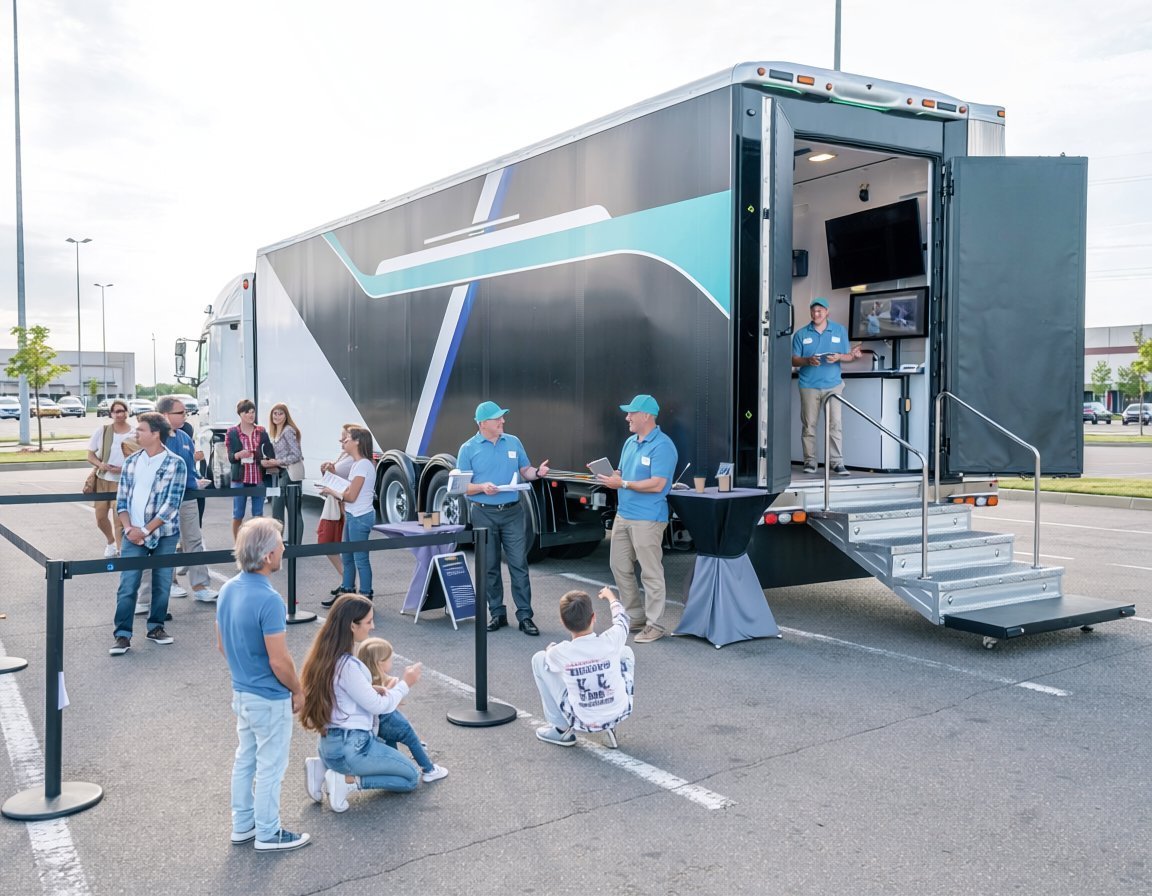
One of the fastest-growing experiential marketing strategies is the mobile tour. Instead of relying on a three-day trade show, organizations deploy branded trucks or trailer-based exhibits that travel directly to audiences across multiple cities. Mobile tours are being used successfully across industries. Educational initiatives have toured college campuses introducing students to career paths in the live events industry through immersive environments. Healthcare technology brands have also launched nationwide touring experiences to reconnect with customers and demonstrate innovations following the return to in-person engagement. The strategy is simple but powerful. If attendees travel to trade shows, brands can travel to their audiences.
Benefits of Mobile Exhibits
• Multi-city engagement from one exhibit investment
• Longer operational lifespan than a single event
• Regional market targeting
• Consistent brand storytelling across locations
• Lower cost per interaction over time
A mobile exhibit may operate for months or years, extending the value of the original investment far beyond a single event.
Corporate Events & Customer Experience Programs
Many organizations now host their own branded events rather than relying solely on industry shows. Examples include:
• Customer summits
• Product launches
• Sales meetings
• Innovation showcases
• Partner conferences
Because attendance is curated, conversations are often more meaningful and aligned with business goals.
Pop-Up Experiences & Temporary Brand Installations
Pop-up activations create immersive brand moments in locations where audiences already gather. Common venues include:
• Transportation hubs
• Retail centers
• Urban public spaces
• Seasonal marketplaces
• Cultural festivals
Pop-ups allow brands to command attention without competing against rows of neighboring exhibitors.
Traveling Exhibits & Educational Experiences
Traveling exhibits extend storytelling across multiple destinations using a single exhibit structure. Ideal uses include:
• Anniversary celebrations
• Corporate heritage storytelling
• Healthcare awareness campaigns
• Advocacy initiatives
• Institutional outreach programs
Because the environment ships from venue to venue, engagement continues long after a typical trade show concludes.
Sports, Fan & Public Engagement Activations
Sports and entertainment events provide emotionally engaged audiences ready to interact with brands. Experiential environments at fan festivals or sponsored activations often produce:
• Higher dwell times
• Stronger emotional connection
• Increased brand recall
• Shareable social media moments
These environments shift engagement from transactional conversations to memorable experiences.
Real-World Experience Beyond the Trade Show Floor
While trade shows remain an important part of many programs, some of the most memorable and impactful face-to-face engagements happen outside the exhibit hall. Over the years, Genesis Exhibits has supported a wide range of non-trade show environments that demonstrate how versatile experiential design can be when applied to different settings. These experiences include:
• A fan-focused exhibit environment for the NHL All-Star Game at Grand Central Terminal
• A series of conferences hosted aboard the QE2 ocean liner, creating fully immersive environments at sea
• A traveling exhibit for Sesame Street’s “Elmo on the Road,” designed to engage audiences across multiple locations
• Press conference environments for Super Bowl events
• A 50th Anniversary traveling exhibit celebrating the Corvette brand
• A global brand launch for S&P Global, implemented across 90+ offices worldwide
• A full-scale soccer event produced on the grounds of the United Nations
• Holiday bazaar pop-up retail environments at Grand Central Terminal
These types of programs highlight an important reality. Face-to-face engagement is not limited by venue, it is defined by experience.
Whether the setting is a transportation hub, a corporate office, a public space, or even an ocean liner, the principles of effective exhibit design remain the same: clear messaging, intuitive flow, and meaningful interaction.
Designing Exhibits for Multi-Event Success
Modern experiential environments are designed differently than single-use trade show booths. Successful programs prioritize:
• Modular construction for reuse
• Lightweight structures for easier logistics
• Flexible graphic updates
• Technology-enabled engagement
• Sustainable materials aligned with the EDPA ESCA EIC Sustainability Guidance for Exhibition Stand Construction
Modular systems support a “reuse and adapt” approach, allowing exhibit structures to evolve across multiple events while minimizing waste and extending lifecycle value. Genesis Exhibits develops branded environments using scalable systems that can adapt across multiple event types, helping companies extend the life and usefulness of their exhibit investment.
Technology Expands Engagement Without Expanding Staff
All types of experiential environments can integrate digital engagement tools that enhance interaction while maintaining efficient staffing models:
• Remote product demonstrations
• Interactive digital storytelling
• AR and VR experiences
• Guided self-service exploration
• Integrated data capture
Technology enables smaller teams to deliver meaningful experiences across multiple locations.
The Future of Face-to-Face Marketing
The most successful brands no longer rely on a single event type. Instead, they build a diversified live marketing strategy that includes:
• Trade show participation
• Mobile tours and roadshows
• Corporate-hosted events
• Pop-up activations
• Traveling exhibits
• Community engagement programs
Each environment plays a role in creating consistent, ongoing engagement throughout the year.
Rethinking Face-to-Face Engagement
If trade shows feel limiting, the opportunity is not to replace them, but to expand beyond them. Face-to-face marketing remains one of the most effective ways to connect with audiences. The difference today is that those interactions are no longer confined to convention centers. They can happen anywhere your audience is. Face-to-face marketing isn’t changing in value. It’s expanding in where and how it happens.