
From the Trade Show Floor to a Second Life
How Genesis Exhibits and Brumark are putting sustainability into practice.
Sustainability has become an important conversation in the exhibition industry. But talking about sustainability and actually building it into the way an exhibit house operates are two very different things. At Genesis Exhibits, that distinction has become increasingly important.
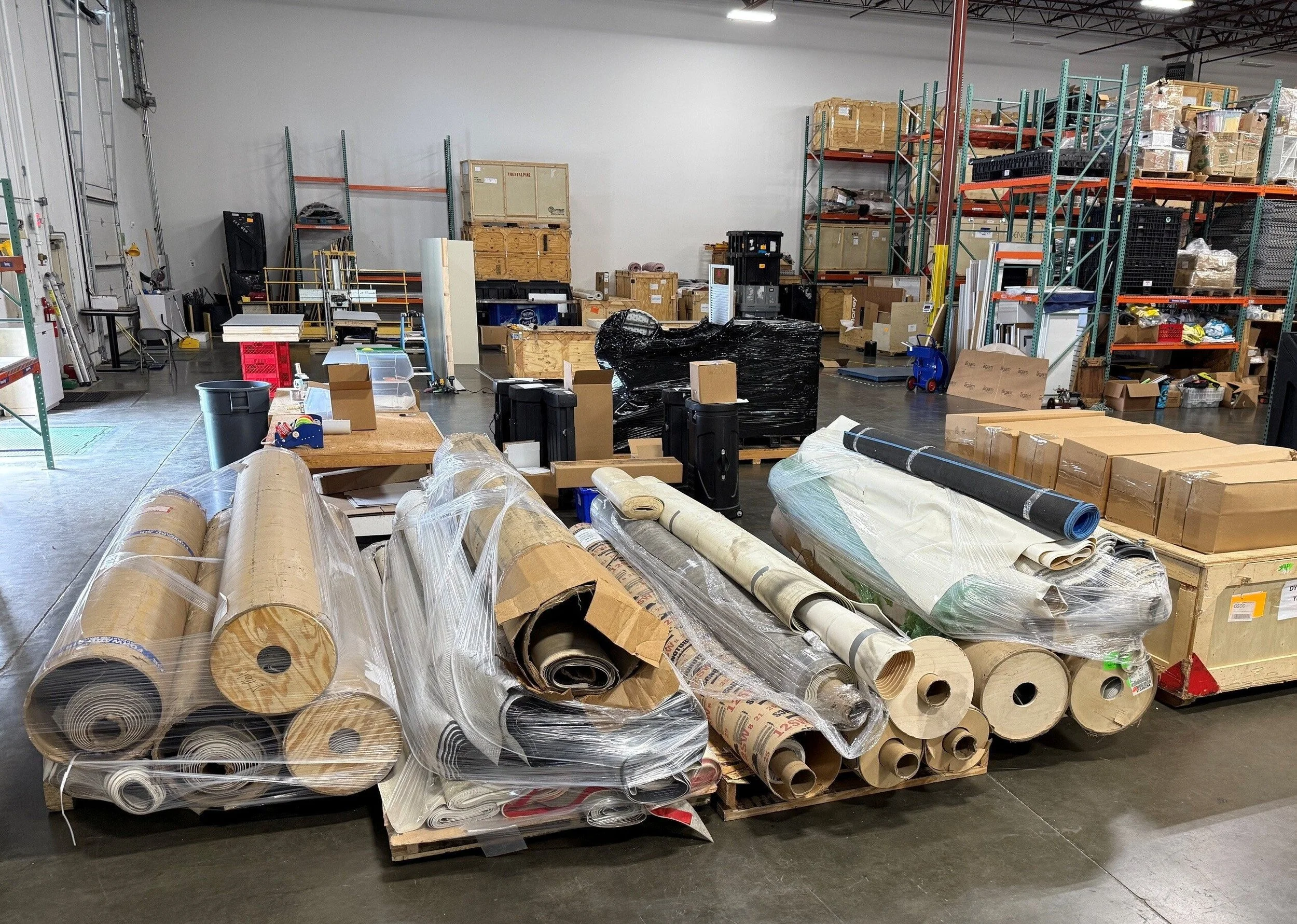
A recent photograph from the Genesis Exhibits warehouse tells a simple story. Pallets of used flooring, padding, and graphics were staged and waiting for pickup. They weren't headed for a dumpster. They were being prepared for recovery through Brumark's recycling program. There is nothing particularly dramatic about a pallet sitting in a warehouse. But what happens to that pallet, and the process that gets it there, is a good example of what it means to put sustainability into practice.
For Genesis Exhibits, the goal is straightforward: maximize the useful life of materials, reuse what can be reused, and, when a material has reached the end of its useful life, find a responsible recovery option. The relationship with Brumark has made that process practical.
It Starts with Reuse
Sustainability doesn't begin with recycling. It begins much earlier, with the decision about whether something needs to be replaced in the first place. When flooring comes back to Genesis Exhibits after a show, the team evaluates its condition and remaining useful life. Wear and tear are considered, as is the client's decision about whether new flooring is needed for a future exhibit. Ultimately, the client makes that decision. If existing flooring can continue to be used, reuse is the preferred option. Genesis Exhibits' goal is to maximize the client's investment and get as much useful life out of the material as possible.
But there comes a point when flooring, padding, or graphics have reached the end of their useful life for the client. That is where having an established recovery process becomes important. As Bobby Diehl, Director of Operations at Genesis Exhibits, puts it, "Our goal is always to maximize our clients' investments by reusing as much as possible, but at a certain point recycling is the next best thing."
That philosophy closely follows the approach outlined in the EDPA ESCA EIC Sustainability Guidance for Exhibition Stand Construction, published as From Build to Breakdown: Sustainability in Exhibitions, which places reducing material use and maximizing reuse ahead of recycling. The guidance also encourages exhibit companies to establish processes for measuring and documenting what happens to materials when they reach the end of their useful life.
The important distinction is that recycling is not being treated as the first answer. It is the next step when a material has reached the end of its useful life and can no longer reasonably be reused.
A Supplier Decided to Do Something About the Waste Problem
Brumark's recovery program grew out of a similar realization. According to Brandie Townsend, Brumark's Sustainability Manager, the conversation that led to the current program began in mid-to-late 2023. The company was looking at sustainability and recognized that, as a supplier and manufacturer serving the exhibition industry, it had an opportunity to take a more active role in addressing the amount of flooring and other material going into landfills.
The company brought Townsend into the organization as sustainability manager and formally launched the recovery program in late 2024. What is notable about the program is that Brumark approached it as a service rather than simply a sustainability statement. The program was piloted, guidelines were developed, responsibilities were defined, and a carrier relationship was established specifically for recovery loads. That matters because recycling only works when there is a practical system behind it. There must be a way to collect the material, move it, sort it, process it, and get it to an appropriate end destination.
Brumark's experience has shown that the process involves considerably more than the supplier and the exhibit house. Clients, general service contractors, carriers, forklift operators, venue personnel, and others all have a role to play. Townsend describes it as bringing an orchestra together. Everyone has a part, and the process works when those parts are coordinated.
Making It Easy at the Warehouse
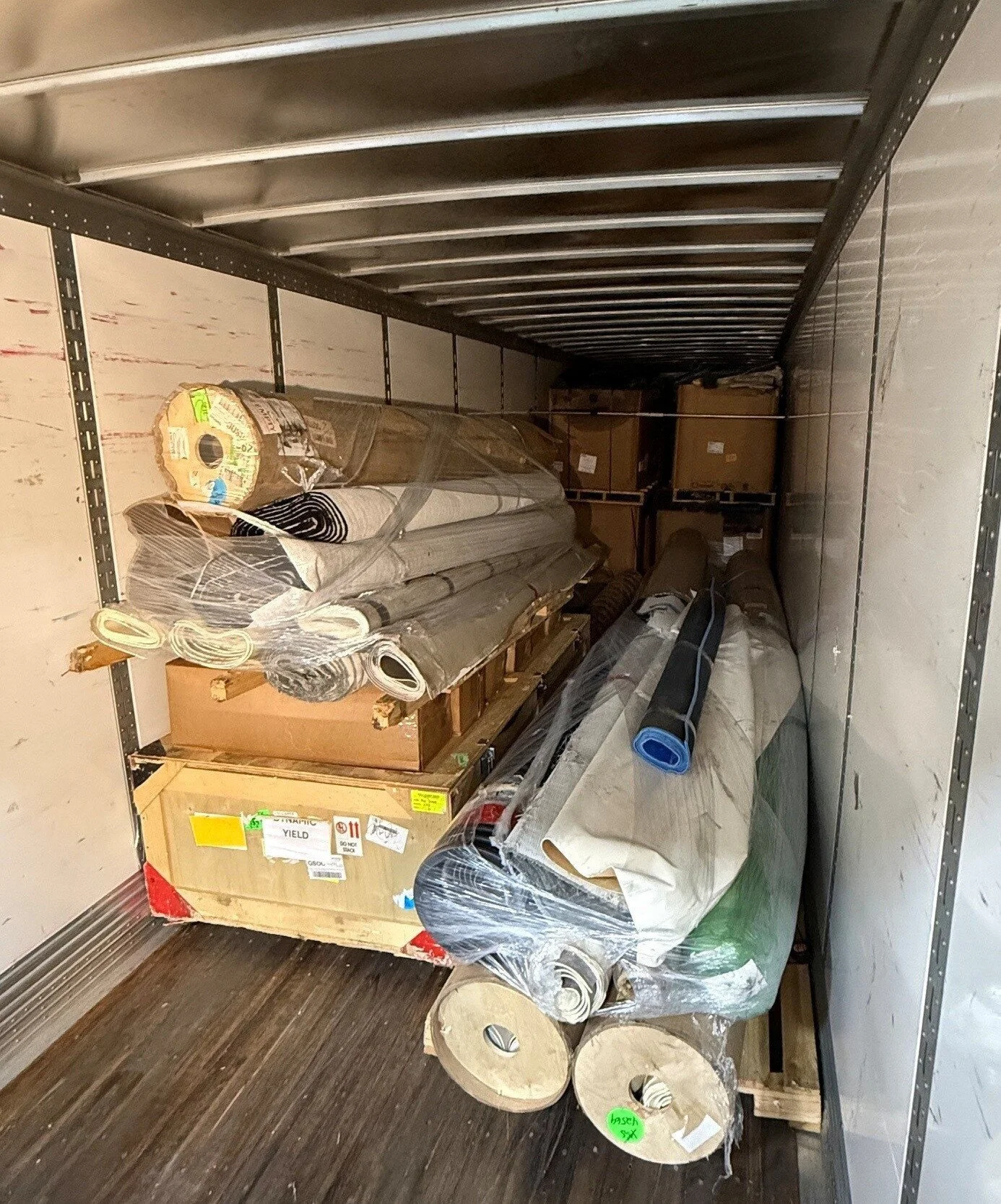
At Genesis Exhibits, the process has become remarkably simple. After a trade show, material that is no longer going to be reused is set aside in the warehouse. Flooring and padding are separated onto different skids, while SEG graphics are boxed and prepared for shipment. Graphics typically go to Brumark about once a month. Flooring is shipped approximately two or three times a year, depending on how much material has accumulated. When the volume reaches the appropriate point, Genesis Exhibits contacts Brumark and arranges the pickup.
Brumark often consolidates recovery shipments, allowing one truck to make multiple stops. That helps maximize trailer space and makes better use of transportation resources. For Genesis Exhibits, that is one of the reasons the program has worked so well. "Honestly, nothing," Bobby says when asked about the biggest operational challenge. "The program Brumark has put together makes the process very easy. Post show, we store the materials to the side. Then once they accumulate to a certain point we reach out and set up the pickup! Super simple!"
And that may be one of the most important takeaways for another exhibit house considering a similar program: it doesn't have to be complicated. Sustainability programs can sometimes seem difficult to implement because they are presented as something that requires a major operational overhaul. In Genesis Exhibits' case, it has become part of the normal warehouse routine—identify material that is no longer being reused, separate it, stage it, and coordinate the pickup. The system works because both sides understand what they need to do.
Everyone Has a Role
The material does need to be handled properly before it leaves the warehouse. Brumark's recovery guidelines require materials to be separated by type and prepared so they can be processed efficiently. Flooring is rolled and secured, and similar materials are bundled together. Graphics are placed into bulk bags. Materials must be dry and free of contaminants such as heavy metal nails or screws.
These details may seem small, but they matter once the material reaches Brumark. The incoming material is checked in, unloaded, and staged according to type. Vinyl is bundled or baled. Padding is baled. Carpet, turf, and textile materials can be cut, shredded, and baled before moving to their next destination. In other words, the process doesn't end when a truck leaves the Genesis Exhibits warehouse. There is a chain of custody that continues through collection, sorting, processing, and delivery to the appropriate recovery outlet. Brumark maintains proof-of-delivery documentation along with the material-handling documentation provided to the carrier. The company also provides monthly certificates to clients documenting recovery metrics.
Genesis Exhibits maintains photographs of loaded trucks and receives post-recycling certificates as part of its own documentation. That documentation matters. It gives Genesis Exhibits and its clients something more meaningful than a sustainability claim: a record of what was shipped and evidence that the material entered a recovery process.
What Happens After the Carpet Leaves?
Perhaps the most interesting part of the process is what happens after Brumark receives the material. There isn't one destination for everything. Different materials have different recovery pathways.
Vinyl bundles currently go to Ohio, where they are recycled into products such as landscape and plumbing hoses and piping. Rebond padding goes back to the padding supplier, where it can be recycled into new Rebond padding. Some carpet, rubber flooring, and artificial turf may be donated to schools for recreational applications when appropriate. Other materials are currently used in cement-kiln applications. Mesh and SEG fabric can also go into cement-kiln applications. Brumark is continuing to develop additional pathways for clean, non-edged fabric and single-polymer carpet, with the goal of creating additional opportunities for those materials to become new products.
The important lesson is that "recycling" is not one single process. The best destination depends on the material, its condition, and the technology and markets available to recover it. Brumark sorts the materials and directs them toward the appropriate processor or end user rather than treating everything as one waste stream.
A Different Kind of End of Life
One of the more unusual recovery pathways involves carpet, turf, and urethane padding. These materials can be used in cement-kiln applications. Once processed and delivered to the kiln, the material is shredded and incorporated into the cement manufacturing process. According to Brumark, the material is first used as an alternative fuel, while its mineral content can become incorporated into the clinker during the cement manufacturing process.
That means the material is not simply being moved from one waste stream to another. It becomes part of another industrial product. It is also an example of why the conversation around sustainability needs to go beyond simply asking whether something is "recyclable." The more useful question is: What can this material become next?
The Scale Is Beginning to Add Up
Individual shipments may not seem significant on their own. But when the process is repeated across hundreds of shows, the numbers begin to tell a much bigger story.
From 2025 through 2026 to date, Brumark reports recovery activity associated with 620 shows, representing approximately 2.09 million pounds (1,045 tons) of material diverted from landfill to its next best use. For the first half of 2026 alone, more than 802 tons have been diverted.
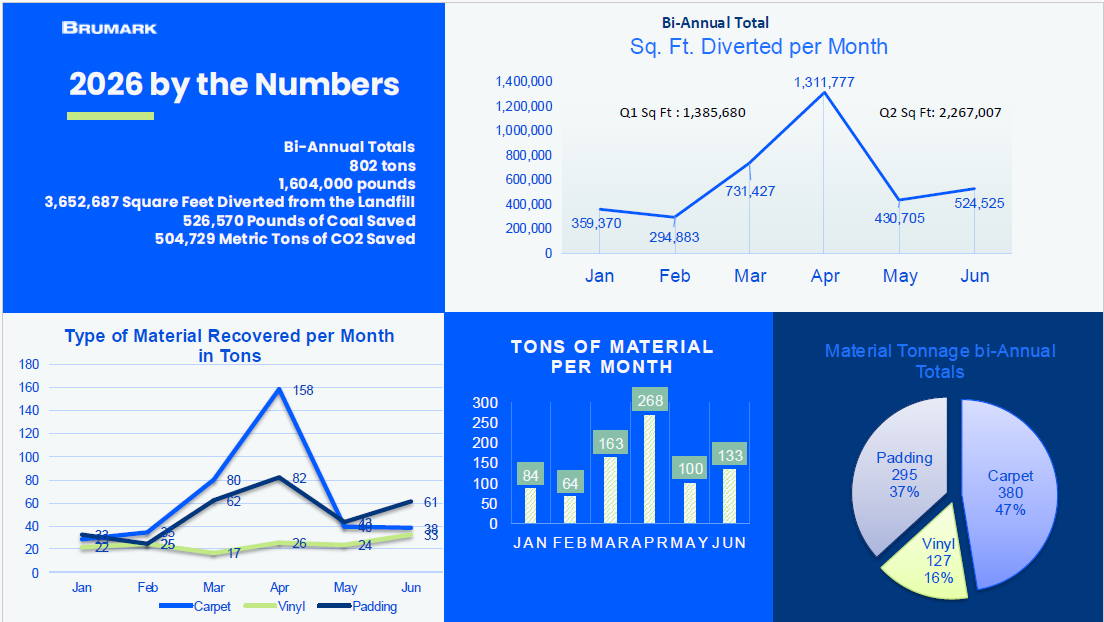
The material is being directed into different recovery pathways depending on what it is and how it can best be utilized. Vinyl, padding, carpet, turf, mesh, and graphics each have different opportunities for recovery, recycling, reuse, or alternative applications. One shipment becomes another, then another. Over time, those individual efforts add up to measurable results and a positive change that becomes increasingly evident show by show.
The numbers are significant, but perhaps the more important story is how those numbers are generated. They come from individual companies making individual decisions about materials after individual shows. That is what makes the process scalable. It doesn't require every exhibit house to transform its entire operation overnight. It starts with identifying materials that have reached the end of their useful life, finding the right recovery pathway, and making that process part of the normal workflow.
Sustainability Becomes Part of the Client Conversation
There is also a business lesson in the process. When customers choose the Brumark recovery option as part of a flooring purchase, the recovery component is incorporated into that purchase as part of the program. That means the end-of-life pathway can be considered when the material is purchased rather than being treated as a problem to solve years later.
For Genesis Exhibits, this creates another opportunity to talk with clients about the lifecycle of the materials being used in their exhibits. The conversation becomes less about simply selecting a floor and more about asking what happens to that floor over time. That is a subtle but important change. Sustainability becomes part of the planning process rather than something that happens after the fact.
One Program Leads to Another
The impact of the Brumark relationship has also extended beyond flooring. Bobby says Genesis Exhibits' objective is now to recycle as much as possible. That mindset has led the company to look at other materials leaving its warehouse, including cardboard and plastic. Genesis Exhibits has recently partnered with a local recycling depot to accept those materials as well.
The experience demonstrates how one successful sustainability process can change the way a company looks at everything else. Once employees begin asking what happens to one material at the end of its useful life, it becomes natural to ask the same question about the next material.
As Bobby puts it, "Now recycling is not only cool but profitable." Not every sustainability initiative will necessarily produce a financial return, but responsible material management and good business practices can coexist. In some cases, a thoughtful approach to material recovery can also create operational or financial benefits.
What Can Other Exhibit Houses Do?
The most encouraging part of the Genesis Exhibits experience may be how easy Bobby says the process has been to implement. When asked what he would tell another exhibit house considering a similar program, his answer was simple: "DO IT!" He points to the satisfaction of knowing that Genesis Exhibits is doing what it can to reduce, reuse, and recycle, as well as the value of being able to share those efforts with clients.
There is no suggestion that recycling alone solves the industry's sustainability challenges. It doesn't. The exhibition industry still has work to do in material selection, booth design, transportation, packaging, reuse, waste reduction, and end-of-life planning. But progress does not have to begin with solving everything. It can begin with looking at what is already leaving your facility and asking a simple question: does this really need to go into the dumpster?
Walking the Walk
That may be the most important lesson from the Genesis Exhibits and Brumark relationship. Sustainability is easy to discuss. It is much more meaningful when you can point to what happens after the show.
At Genesis Exhibits, that means evaluating whether materials can be reused, setting aside those that have reached the end of their useful life, separating them appropriately, coordinating recovery pickups, and documenting what happens next.
At Brumark, it means building the infrastructure to collect, sort, process, and direct those materials into appropriate recovery pathways. Neither company suggests that the exhibition industry's waste problem has been solved. What they are demonstrating is that a practical process can be put in place today.
For other exhibit houses, the lesson is simple: start by looking at what is going into your dumpster and what you are paying to have hauled away. Understand what can be reused or recovered. Establish a relationship with a recovery partner. Create a staging process. Train the people involved. Document the results. Then look for the next opportunity.
The end of a trade show does not have to mean the end of a material's useful life. And sustainability does not have to remain a talking point. Sometimes it looks like a pallet sitting in a warehouse, waiting for a truck. That pallet represents a decision that has already been made: this material is not waste yet. Let's see what it can become next.
Thank you very much for taking the time to review my article. I invite you to explore our Case Studies and of course reach out if you have any questions, requirements or ideas to share.