
IMTS 2026 at McCormick Place: The Modern Exhibit Is More Than a Booth
IMTS 2026, The International Manufacturing Technology Show, brought more than 90,000 registrants, 1,788 exhibiting companies, and visitors from all 50 states and 113 countries to McCormick Place in Chicago. Across roughly 1.17 million square feet of exhibit space, attendees explored machining, automation, robotics, additive manufacturing, artificial intelligence, software, metrology, tooling, connected systems, and other manufacturing technologies.
Those numbers tell you something about the scale of IMTS. But the more interesting story is what happened inside all that space. Visitors arrived with real production challenges. Exhibitors demonstrated practical solutions. Conversations became action plans, relationships were strengthened, and manufacturers compared technologies and explored investments. In other words, IMTS wasn't simply a technology showcase. It was a marketplace for solving problems.
That distinction matters for anyone involved in B2B trade shows. As products become more sophisticated and business decisions more complex, the value of an event isn't simply putting a product in front of a large audience. It comes from bringing the right people, technology, information, and conversations together in one place.
Douglas K. Woods, president of AMT (The Association For Manufacturing Technology), described manufacturing as “a community of people who make things and solve problems.” He also emphasized that the real measure of IMTS would be what happened afterward: the investments manufacturers make, the technologies they put to work, and the relationships they build. That's a useful way to think about trade shows in general. The event itself is only one part of the process.
The Exhibit Is Becoming Part of the Customer Journey
Traditionally, the word “booth” describes the physical space an exhibitor occupies at a trade show: the structure, graphics, lighting, products, demonstrations, meeting areas, and branding on the show floor. That definition still works, but it no longer captures everything an effective exhibit needs to accomplish. The modern exhibit is more than a booth. It is part of a connected sequence of content, experience, conversation, and follow-through.
Today's buyers are often well informed before they ever arrive at an event. A prospective customer may have already encountered a company through search, social media, email, a sales call, a webinar, an industry publication, digital content, or a previous event. By the time that person walks into the booth, the physical experience may be several steps into the relationship rather than the beginning of it.
The exhibit needs to continue that conversation. Messaging should reinforce what visitors already know while giving them something they cannot get from a website or brochure. Booth staff should be ready to move beyond general information into meaningful discussions. And when a visitor leaves, there should be a clear reason and mechanism to continue the relationship. That's why exhibit strategy can't be separated from content, sales, event marketing, demonstrations, technology, staffing, and post-show follow-up. They are different parts of the same customer journey.
The Power of Demonstration
IMTS also reinforces an important principle for companies selling sophisticated B2B products and technologies: one of the strongest forms of proof is still a live demonstration that connects the technology to the larger workflow. That is particularly relevant in manufacturing because most technologies don't operate in isolation. A machine exists within a production process. Automation interacts with equipment and people. Software connects systems and data. Robotics changes how materials move. Artificial intelligence increasingly becomes part of larger production and decision-making processes.
Often, the real value isn't found in one piece of technology. It's found in how those technologies connect. That can be difficult to communicate through graphics or brochures. Video can explain a great deal, but it still asks the viewer to translate what they're seeing into their own operation. A well-planned live demonstration closes some of that gap. Visitors can see how a system operates, ask questions in the moment, and understand not only what a product does but where it fits and why it matters. For complex or high-investment purchases, that's a critical shift. The conversation moves from “What is this?” to “How would this work for us?” That's a far more valuable conversation.
The Workflow Is the Story
One of the challenges facing exhibitors today is that technology itself is not always enough to differentiate an experience. Artificial intelligence is a good example. It's easy to say a product uses AI. It's much more useful to demonstrate where AI fits into an operation, what problem it addresses, and what changes as a result. The same principle applies to automation, robotics, software, digital manufacturing, and connected systems. Buyers want context. They want to understand integration, implementation, training, operator experience, and practical outcomes. They want to know how a technology fits into the larger workflow rather than simply hearing a list of features.
That's one reason an event like IMTS works so well as a physical experience. McCormick Place becomes an environment where visitors can see technologies side by side, compare different approaches, and better understand the relationships between systems. For exhibitors, there's an important lesson here: don't just demonstrate the product. Demonstrate the problem, the process, and the role your solution plays within it. The workflow is often the better story.
Human Connection Still Drives the Experience
As technology becomes more sophisticated, it might seem logical that trade shows would become increasingly automated and digital. In practice, the opposite can also be true. The more complicated the technology becomes, the more valuable a good human conversation can be. A visitor may see a demonstration and recognize a challenge in their own operation. An engineer may want to discuss integration. An executive may want to understand the business case. An operator may have entirely different questions about implementation or usability. Those conversations are difficult to script, which is exactly why they matter.
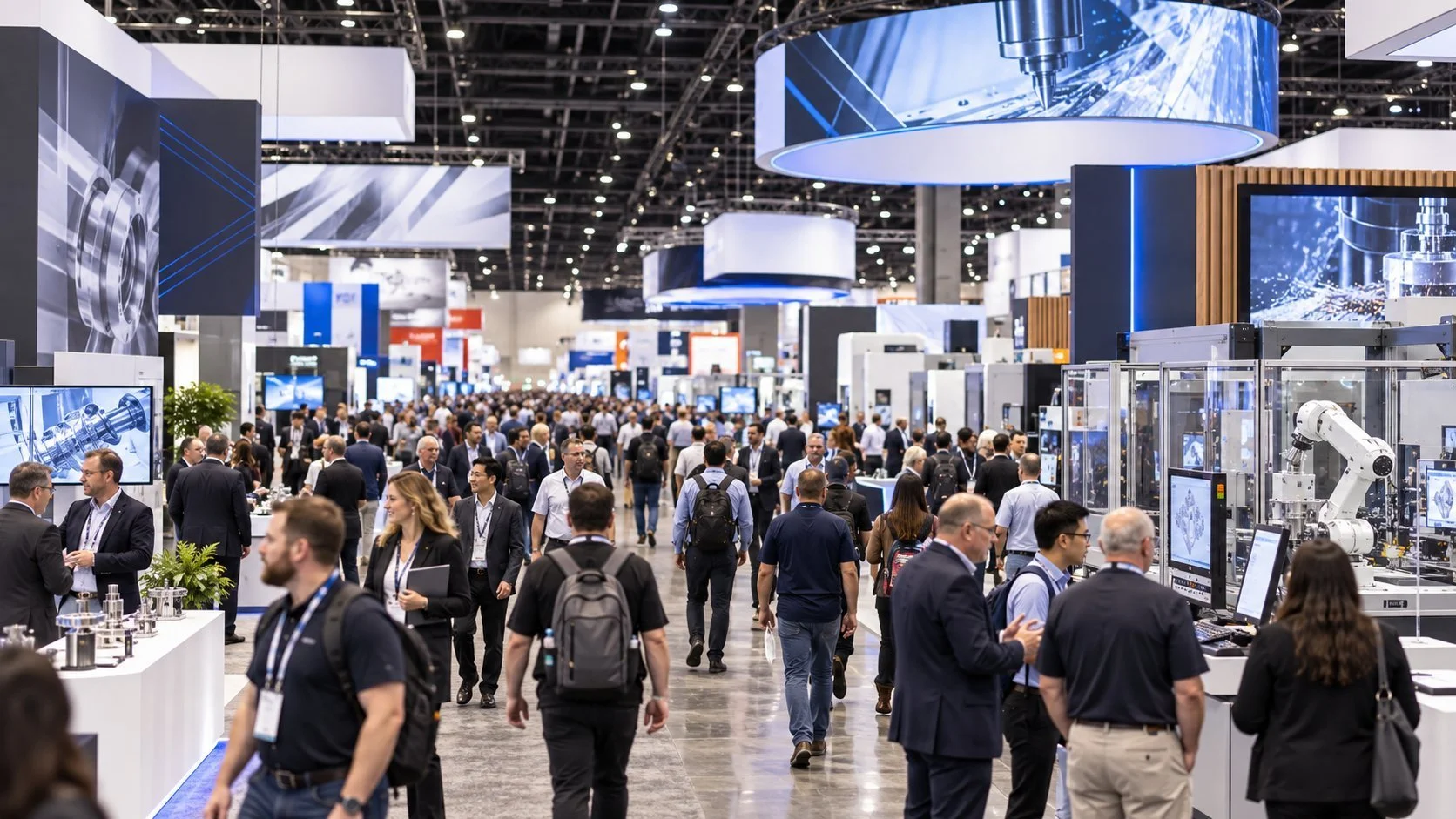
The best exhibit environments provide enough structure to guide visitors without making the experience feel controlled. They put the right information, demonstrations, and people in the right places while leaving room for visitors to ask questions and take the conversation in the direction that's relevant to them. This is also why booth staffing should be considered part of exhibit design. A beautiful environment can't compensate for a team that's unprepared to engage visitors. Likewise, a great sales team can struggle in a booth that creates congestion, makes demonstrations difficult, or provides nowhere to have a serious conversation. The physical environment and the human experience have to work together.
What Happens After the Show Matters
Perhaps the most important lesson from IMTS is what happens after everyone leaves McCormick Place. A busy booth can look successful, but visitor volume alone doesn't tell the entire story. A lead can be valuable, but it's only the beginning. A demonstration can create interest, but its business value depends on whether that interest leads to another conversation or action.
The trade show therefore needs to be viewed as part of a longer process. Pre-show communication creates awareness. The booth creates an experience. Demonstration provides proof. Conversation establishes relevance. Follow-up creates an opportunity for action. When those pieces are connected, the event becomes much more than a few days on the show floor.
That's also why post-show follow-up shouldn't be treated as an administrative task that begins once the crates are packed. The follow-up strategy should influence lead capture, staffing, content, demonstrations, and engagement planning before the show opens. If you don't know what you want a visitor to do next, it's difficult to design an effective experience for what happens now.
Why Physical Trade Shows Still Matter
IMTS also offers a useful answer to a question the event industry has been discussing for years: Why travel to a large physical event when so much information is available online? For complex products, the answer becomes fairly clear. People can research a machine online. They can download specifications, watch videos, attend webinars, and schedule virtual meetings. All of those tools are valuable. But they don't completely replace seeing technology operate in person, discussing it with an expert, comparing approaches in real time, and talking through how a solution could apply to a specific operation.
Physical events create density. They bring technology providers, experts, buyers, partners, and industry peers into the same environment. At a show the scale of IMTS at McCormick Place, that concentration creates opportunities for connections that would be difficult to reproduce one scheduled digital interaction at a time.
A visitor may arrive looking for one solution and discover another. An engineer may encounter a technology that changes how they think about an existing process. A manufacturer may realize that technologies previously evaluated separately make more sense as part of a larger system. That's why the enduring value of a trade show isn't simply access to information. It's interaction with information, technology, and people.
A Different Way to Think About Exhibit Design
For exhibitors, all of this changes the design conversation. It's easy to begin with square footage, architecture, graphics, lighting, technology, or traffic flow. Those things matter, but they should support a larger objective: what should a visitor understand, experience, and do during the time they spend with your company?
Before deciding what the booth should look like, consider what brought the visitor there. What do they need to understand? What can you demonstrate better in person than online? What requires a human conversation? What should they remember afterward? And, most importantly, what should happen next?
Those questions lead to better design decisions because they put the visitor experience ahead of the physical structure. The result can still be visually impressive. But now the visual design has a purpose. The demonstration has a purpose. The meeting space, digital technology, graphics, and staffing all have a purpose. The booth becomes an environment designed to help visitors understand something that matters to them.
The IMTS 2026 Lesson
The significance of IMTS 2026 goes well beyond its size. More than 90,000 registrants came to McCormick Place, where 1,788 exhibiting companies demonstrated manufacturing technologies across roughly 1.17 million square feet of exhibit space. That scale is impressive, but the reason people came is more important. They had problems to solve, technologies to evaluate, relationships to build, and decisions to make.
Travis Egan, chief revenue officer of AMT, has described IMTS as “a catalyst for performance” where people, products, and process technologies come together. That's also a useful description of what a modern B2B trade show can become when the experience is designed with intention.
Two ideas stand out. The modern exhibit is more than a booth. It is a connected sequence of content, experience, conversation, and follow-through. And for companies selling sophisticated products or technologies, a live demonstration remains one of the most effective ways to connect a solution to the real-world workflow. The first idea is about the journey. The second is about proof.
Together, they describe a booth that does more than attract attention. It creates an environment where visitors can recognize a problem, experience a solution, have a meaningful conversation, and understand what should happen next. For exhibitors planning future IMTS appearances at McCormick Place—or any complex B2B trade show—that may be the most useful lesson to carry forward.
The booth is the environment. The experience is the strategy, the demonstration is the proof, and the follow-through is where the opportunity continues.
Thank you very much for taking the time to review my article. I invite you to explore our Case Studies and of course reach out if you have any questions, requirements or ideas to share.