
The AI Infrastructure Boom is Creating a New Need for Branded Experiences
Why data centers, power systems, cooling technology, chips, and workforce recruiting now need better physical storytelling.
Artificial intelligence may feel invisible. Most people experience it through software: chatbots, search tools, image generators, productivity apps, coding assistants, analytics platforms, and enterprise automation. But behind all of that is something very physical.
AI depends on data centers, chips, servers, power systems, cooling equipment, fiber networks, electrical infrastructure, cloud platforms, semiconductor manufacturing, and the skilled people who build and maintain it all. The more AI grows, the more important that physical infrastructure becomes. That creates a practical challenge for the companies building this economy: How do you clearly explain something that most people never see?
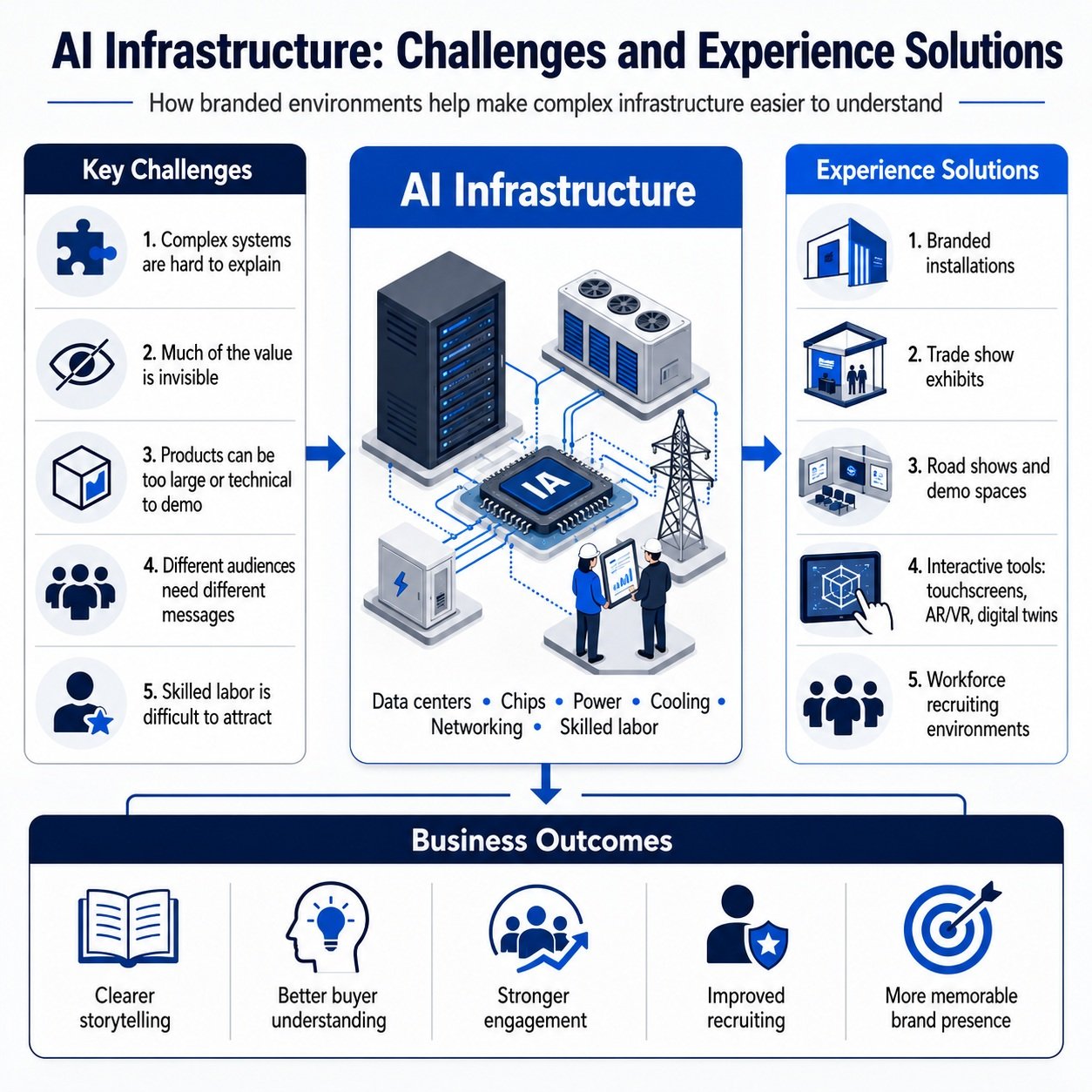
That question matters more than it may seem. A company may have a breakthrough cooling system, a more efficient power solution, a better AI server architecture, a faster deployment model, or a smarter way to train technical workers. But if buyers, partners, recruits, or investors cannot quickly understand why it matters, the value gets lost. That is where branded environments become especially useful.
At Genesis Exhibits, we have always believed that a strong physical experience can make a complex message easier to understand. In the AI infrastructure market, that idea is becoming even more relevant.
AI is digital. The infrastructure is industrial.
The public conversation around AI usually focuses on models, apps, and software platforms. But the AI economy is also an industrial buildout.
Data centers are expanding. Semiconductor companies are racing to support demand. Power and cooling systems are becoming more important. Networking and fiber infrastructure matter more than ever. Skilled trades and technical labor are becoming part of the AI supply chain.

When people talk about “compute,” they are really talking about the processing power needed to train and run AI systems. Compute is the productive capacity behind AI. Data centers are the factories. Chips are the engines. Electricity is the fuel. Cooling keeps everything running. People design, build, wire, operate, and maintain the whole system.
That is a big story to tell. And for many companies in this space, it is not easy to tell with a simple booth graphic, brochure, or product sheet.
The biggest challenge is making the invisible visible.
A lot of AI infrastructure value happens behind walls, inside racks, under floors, across networks, or inside highly controlled facilities. That is true for data center infrastructure companies, power equipment manufacturers, cooling technology providers, semiconductor suppliers, AI hardware companies, construction firms, engineering groups, and workforce development organizations. The product may be real and physical, but the value is often hidden.
A cooling company, for example, is not just selling hardware. It is selling thermal control, uptime, efficiency, density, and risk reduction. A power company is not just selling equipment. It is selling resilience, speed-to-deployment, safety, and confidence. A workforce organization is not just promoting jobs. It is helping people understand how electricians, technicians, and skilled trades are connected to the future of AI.
That kind of story needs context. A well-designed trade show exhibit, branded installation, road show, executive briefing center, or recruiting environment can create that context. It gives people a way to see how the pieces fit together. Instead of saying, “Here is our product,” the experience can say: “Here is the problem. Here is why it matters. Here is where we fit. Here is how we make the system work better.” That is a much stronger conversation.
This is where branded installations can do real work.
A branded installation is more than a display. At its best, it is a business communication tool. For AI infrastructure companies, a branded environment can help explain complex systems, support technical sales conversations, demonstrate products that are too large or sensitive to bring to a show, recruit skilled workers, educate stakeholders, and make a company feel more credible and memorable. That could take the form of a trade show exhibit, a lobby installation, a mobile road show, a customer experience room, a product demonstration space, a corporate meeting environment, or a workforce recruiting activation.
The format can change, but the purpose is the same: help people understand something important more quickly and more clearly. This is especially valuable in technical markets where buying decisions involve engineers, executives, procurement teams, facility managers, investors, and end users. Each group may care about something different. A strong branded environment can help bring those perspectives together. It can show the engineering story, the business story, and the human story in one place.
A practical example: showing the “AI factory.”

One helpful way to explain AI infrastructure is to think of the data center as an AI factory. Power enters the facility. Cooling protects the equipment. Servers and chips process the workload. Networking connects everything. Software monitors performance. Technicians keep the system operating. The customer receives AI capability, speed, reliability, or cost savings. That full picture is hard to explain with a single graphic.
But inside a branded experience, it can become a guided journey. A visitor could move through the story of power, cooling, compute, networking, operations, and outcomes. A touchscreen could show how the system works. A physical model could demonstrate how a product fits into the larger environment. A digital twin or augmented reality overlay could make internal processes visible. A remote expert could join from a lab or facility. A recruiter could use the same environment to explain career paths in data center operations, electrical work, cooling technology, or semiconductor manufacturing.
Now the experience is not just attractive. It is useful. It helps sales teams sell. It helps technical teams explain. It helps recruiters recruit. It helps buyers remember.
The labor story is a major part of the opportunity.
One of the most interesting parts of the AI infrastructure boom is that it depends heavily on people. AI may automate certain tasks, but the infrastructure behind AI requires electricians, electrical engineers, HVAC technicians, pipefitters, fiber technicians, construction managers, data center operators, safety professionals, cleanroom technicians, and field service specialists. That creates a new role for branded experiences.
Companies and workforce organizations need better ways to show people what these careers look like. A standard recruiting table can only do so much. A student, veteran, career changer, or job seeker may not understand what a data center technician does, how electrical work connects to AI, or why cooling systems are becoming so important. A mobile or event-based workforce experience can make those career paths more real.
Instead of handing someone a flyer, an organization can invite them into a simulated environment, show them a day in the life of a technician, walk them through a troubleshooting scenario, or help them choose a training path. That turns recruiting into an experience, not just a conversation. For the AI infrastructure economy, that matters. The companies that can attract, train, and retain skilled people will have an advantage.
The labor story is a major part of the AI infrastructure opportunity. Genesis Workforce Experience Labs, together with our Build the Backbone™ workforce roadshow concept, is our dedicated approach to helping organizations turn skilled trades recruiting, workforce education, and career-pathway storytelling into high-impact physical experiences.
Immersive technology can help, but only when it serves the message.
Interactive technology is a natural fit for this market, but it has to be used with purpose. Touchscreens, augmented reality, virtual facility tours, digital twins, product animations, remote expert demos, and engagement analytics can all be valuable. But the goal should never be technology for its own sake.
The goal is clarity. Can the interactive experience help someone understand how a cooling system works? Can it show how power moves through a facility? Can it explain a semiconductor process that is impossible to see in person? Can it help a recruit imagine themselves in a technical career? Can it capture better information for post-show follow-up? If the answer is yes, then immersive technology becomes more than a novelty. It becomes part of the sales, education, and recruiting process. That is where the combination of physical design and digital interaction becomes powerful. That’s where Apprupo Tech Enhanced Experiences, a boutique agency division of Genesis Exhibits, comes into play. Learn more here.
Why this matters now.
The AI infrastructure market is moving quickly. Companies are trying to win customers, secure partners, attract investors, recruit talent, and stand out in crowded technical markets. In that kind of environment, the best product does not always win by itself.
The company that explains its value clearly often has the advantage. That is why trade show exhibits, branded installations, executive briefing spaces, road shows, and workforce activations are becoming more important for AI infrastructure companies. They create focused moments of understanding. They help people see the full system. They make the abstract more tangible. And in a market built around highly complex physical systems, tangible matters.
How Genesis Exhibits can help.
Genesis Exhibits helps companies create branded environments that turn complex ideas into meaningful experiences, and we’ve been hitting it out of the park for almost 40 years.
For companies in AI infrastructure, data centers, semiconductor manufacturing, power systems, cooling technology, advanced manufacturing, cloud infrastructure, and technical workforce development, that can mean many things.
It may mean a trade show exhibit that explains a complex product more clearly. It may mean a road show that brings a technical story directly to customers. It may mean a corporate installation that helps visitors understand the company’s role in the AI economy. It may mean a recruiting environment that helps people see themselves in the skilled careers behind AI.
The common thread is simple: make the story easier to understand, easier to remember, and easier to act on. AI may be changing the world through software, but the infrastructure behind it is built in the physical world. That physical world needs better storytelling. Genesis Exhibits is built for that challenge.
Ready to make complex infrastructure easier to understand?
If your company is part of the AI infrastructure, data center, semiconductor, power, cooling, advanced manufacturing, or technical workforce economy, Genesis Exhibits can help you create a branded environment that brings your story to life.
Explore our trade show exhibits and branded corporate installation capabilities or contact Genesis Exhibits to discuss how your next trade show, road show, corporate environment, or recruiting experience can become a stronger platform for engagement.