
What every exhibitor should understand before building their trade show budget.
As companies begin to construct their future trade show budgets, there is one number I think deserves more attention. According to a recent EXHIBITOR Magazine breakdown of how exhibiting dollars are typically spent, 41% of the total exhibiting budget goes toward booth space. Think about that for a moment. Nearly half of the investment can go toward renting the physical space inside a convention center. That money does not buy the exhibit, graphics, lighting, furniture, technology, product displays, or anything else that communicates your brand. It buys the concrete floor on which your exhibit will sit.
I’ve used an analogy with clients for years that makes this easier to put into perspective: exhibiting at a trade show is a lot like buying a house. When you buy a larger house, the cost does not stop with the purchase itself. You still have to furnish it, pay utilities and taxes, maintain the property, take care of the landscaping, and handle all of the other expenses that come with owning it. Generally speaking, the larger the house, the more it costs to make the house functional and maintain it properly.
The same principle applies to exhibiting. When you commit to a large island space, you also have to create an exhibit that fills that space appropriately. More square footage can mean more flooring, lighting, furniture, graphics, electrical service, shipping, material handling, and installation and dismantling labor.
The cost of the space is only the beginning. And here is the part worth remembering; attendees never see the concrete floor you rented. They see your exhibit. That distinction should have a lot to do with how you build your budget.
Bigger Isn’t Always Better
There has always been a tendency in our industry to associate a larger footprint with a stronger presence. Sometimes that is true. A larger exhibit can give you room for product demonstrations, hospitality, private meetings, technology, and multiple conversations happening at once.
But square footage by itself does not create impact. A well-designed 20' x 20' island can accomplish more than a poorly planned 20' x 30' island. A smaller exhibit with strong branding, good lighting, compelling product presentation, comfortable meeting areas, and the right technology can make a much stronger impression than a large space that feels empty or underutilized.
Before increasing your footprint, consider what you actually need the space to do. Do you have enough products, demonstrations, meetings, or activities to make the additional area productive? Can you staff it properly? Will the added square footage help generate enough additional business to justify not only the higher space cost, but all of the related costs that come with it?
Sometimes the better decision is to take less space and invest more in what happens within it. The objective should not be to occupy the most floor space. It should be to make the most of the space you have.
Look Beyond the Cost of the Space
The rest of the EXHIBITOR Magazine budget breakdown is equally interesting because it shows how quickly the cost of exhibiting spreads into other areas.
Show services account for approximately 12% of the budget, and this is one of the areas that can surprise exhibitors who have not planned carefully. Electrical service, material handling, rigging, cleaning, internet, and other services provided through the show’s general contractor or designated providers are separate from the cost of designing, purchasing, or renting the exhibit itself.
Material handling deserves particular attention because it is often confused with shipping. Shipping gets your exhibit to the advance warehouse or show site. Material handling, commonly called drayage, covers the movement of that freight from the receiving point to your exhibit space and back again after the show. These costs can increase quickly as an exhibit becomes larger, heavier, and more complicated.
Travel and entertainment represent another 12%. That is significant because the people representing your company are just as important as the environment you put them in. Travel, lodging, meals, and related expenses are part of the exhibiting investment, so staffing budget decisions should be based on more than simply how many people can fit in the exhibit.
Design and graphics account for about 11%, which I find particularly interesting when compared with the 41% allocated to space. These are the elements attendees actually experience. They help communicate who you are, what you offer, what products or services deserve attention, and why someone walking the aisle should spend time with your company. An exhibit needs to do much more than look attractive. It needs to support conversations, make products understandable, reinforce the brand, and create an environment in which attendees can quickly determine whether there is a reason to engage. If 41% is going toward the floor and only 11% toward design and graphics, it is worth asking whether the balance is right for your particular program.
Design Decisions Affect Logistics, Too
Shipping and transportation account for another 8% of the typical exhibiting budget, and these costs should be considered while the exhibit is being designed, not after it has already been built.
Weight, dimensions, crate count, packaging, shipping distance, scheduling, and the complexity of installation can all affect the final cost. An exhibit may look terrific on a rendering, but if it is unnecessarily heavy, difficult to pack, or overly complicated to assemble, those decisions can follow you from show to show in the form of higher operating expenses.
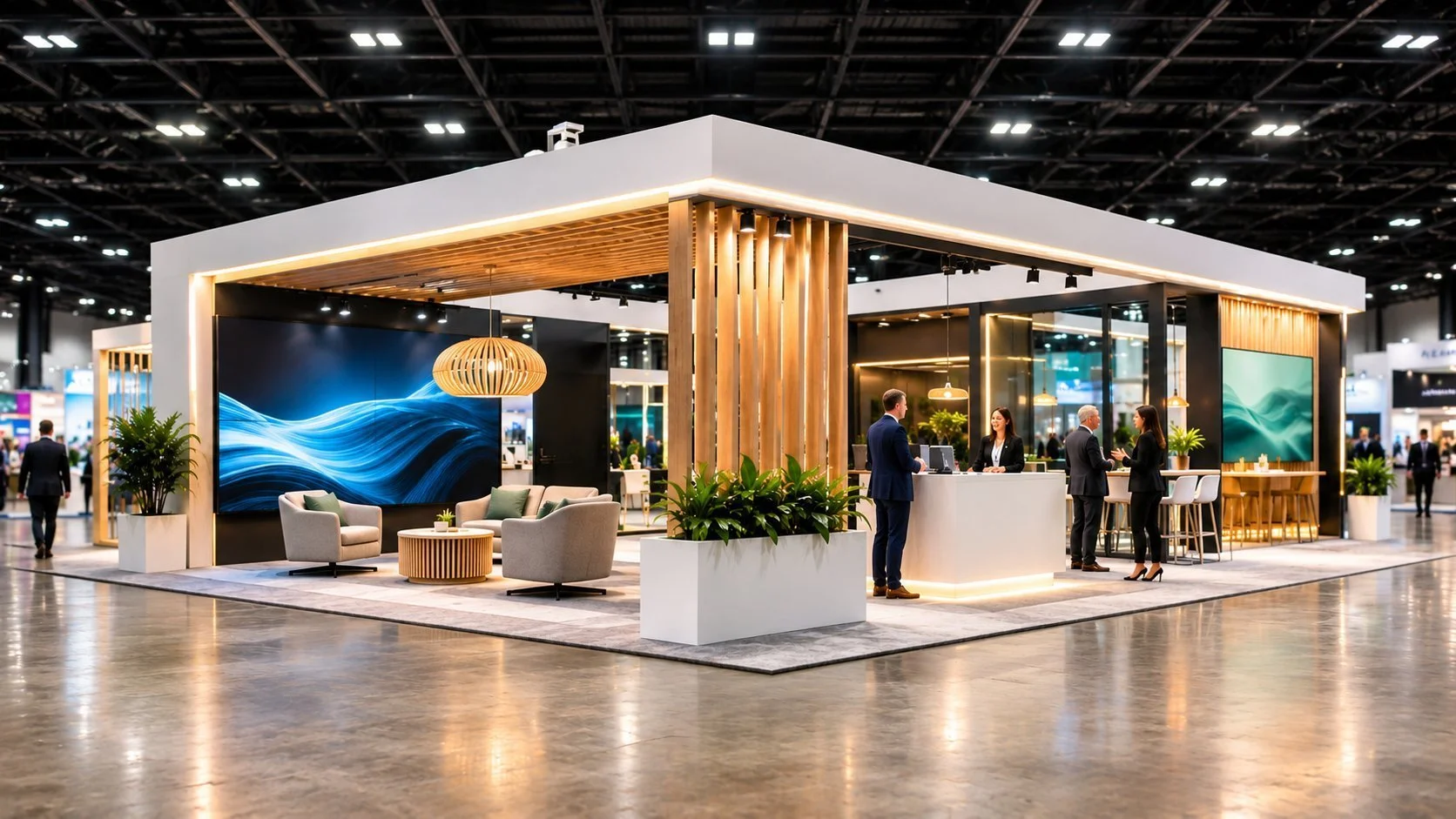
This is one reason reusable modular exhibit design can make sense for many programs. A well-planned modular structure can be reconfigured for different applications and exhibit sizes, while graphics and selected components can be refreshed as the brand or messaging changes.
The real objective is not simply to reduce the initial cost. It is to get more useful life and more flexibility from the investment over multiple shows. That same thinking should be part of the rent-versus-purchase conversation. A company exhibiting frequently may find value in owning a reusable exhibit. Another company with fewer events, changing space requirements, or a desire to avoid storage and maintenance may find rental more practical.
There is no universal answer. The right decision depends on the show schedule, objectives, footprint requirements, and the way the exhibit will be used over time.
Are We Underinvesting in What Happens Before and After the Show?
Two of the smallest percentages in the budget breakdown may actually deserve some of the biggest conversations. Lead management and measurement receive only about 2% of the typical budget.
That is remarkable when you consider how much companies invest simply to get onto the show floor. If a significant amount of money is being spent on space, exhibit design, travel, logistics, show services, and staffing, there should also be a serious plan for determining whether the investment produced results.
After the show, management should be able to understand how many qualified leads were generated, how many meaningful customer conversations took place, how many appointments became legitimate sales opportunities, what revenue can eventually be connected to those opportunities, and whether the show deserves a place in next year’s program. Without measurement, it becomes very difficult to distinguish a successful trade show from an expensive tradition.
Pre-show promotion receives another 2%, and I think that deserves a closer look as well. Companies can spend heavily on the exhibit itself and then rely almost entirely on show management to deliver the right people to it. That is a missed opportunity. The work of attracting attendees should start before the doors open. Targeted outreach, personal invitations from the sales team, appointment scheduling, customer communication, and thoughtful social media activity can all help create a reason for the people you want to meet to make your exhibit part of their plan. You are already investing in being there. It makes sense to invest in getting the right people there with you.
The 1% That May Be Far Too Low
One percentage in particular stands out to me: booth staff training at just 1%. In my opinion, that is far too low. You can have the most impressive exhibit on the show floor, but ultimately, it is your people who turn an attendee’s visit into a business conversation.
Staff members need to know why the company is exhibiting, who they are trying to meet, how to begin a conversation naturally, how to qualify an opportunity, how to demonstrate a product effectively, what information needs to be captured, and what should happen after the show. That preparation should not consist of a quick meeting shortly before the exhibit hall opens. Staff training should be part of the planning process. If I had to choose between a few hundred additional square feet of unnecessary exhibit space and a better-prepared team, I would put more of the investment into the people.
Budget for the Costs That Aren’t on the Rendering
As budgets are being developed, exhibitors also need to be realistic about what it takes to get an exhibit to the show floor and make it operational. Shipping, material handling, installation and dismantling labor, electrical service, rigging, cleaning, internet, and other show-related services can place considerable pressure on the budget. These are different expenses from the cost of purchasing or renting the exhibit itself, and they should be accounted for separately from the booth space rental charged by the show organizer. They are also not expenses you want to discover after the exhibit budget has already been approved.
Build reasonable allowances into the plan from the beginning, along with some contingency for schedule changes, rush requirements, special handling, or other unexpected conditions. A budget that works only when everything goes perfectly is probably not a realistic trade show budget.
Sustainability and Financial Planning Can Support Each Other
Budget planning is also a good time to look at the useful life of the exhibit. Can the structure be reused and reconfigured from one show to another? Can graphics be replaced without replacing the underlying exhibit? Can shipping weight or packaging be reduced? Are there opportunities to source materials and services closer to the event? Can the exhibit be designed today with future configurations already in mind? These are sustainability questions, but they are also financial questions.
The EDPA ESCA EIC Sustainability Guidance for Exhibition Stand Construction offers useful direction for exhibitors and exhibit professionals looking to make more responsible decisions about materials, reuse, refurbishment, logistics, and the overall life cycle of an exhibit. Good sustainability practices and good financial planning are not necessarily competing objectives. Reuse, thoughtful material selection, efficient transportation, and longer useful life can reduce waste while helping companies extract more value from their exhibit investment.
Start With the Experience, Not the Square Footage
As you build your next trade show budget, I would encourage you to change the order of the conversation. Do not begin with, “How large an exhibit can we afford?” Begin with what you are trying to accomplish.
Think about who you need to attract, what you want those people to experience, what products or services need to be presented, what demonstrations or meetings need to take place, and what kind of environment will support those objectives. Once those questions are answered, determine how much space you realistically need and build the rest of the budget around making that space productive.
That brings us back to the house analogy. You would not buy a much larger home simply because you could afford the purchase price, only to discover afterward that there was not enough money left to furnish it properly, operate it, or maintain it. Trade shows are no different. Do not spend so much renting the floor that you do not have enough left to create an exhibit worth visiting.
The goal is not to have the biggest exhibit on the show floor. It is to have the right space, the right environment, the right people, the right message, and the right strategy to turn your exhibiting investment into business results. That is the conversation worth having before your next trade show budget is approved.
Dive deeper: EXHIBITOR Magazine — “How Your Trade Show Exhibiting Dollars Are Spent”
Thank you very much for taking the time to review my article. I invite you to explore our Case Studies and of course reach out if you have any questions, requirements or ideas to share.