
When Things Go Wrong at a Trade Show: The Real Value of an Event Partner
Recently, I had the opportunity to participate in "Event Horror Stories... Tales from the Trenches and How I Survived Them," a webinar hosted by Dahlia El Gazzar and featuring Barb Campbell and Amanda Eberle. As expected, the stories ranged from amusing to stressful, but each illustrated an important reality about our industry. No matter how carefully an event is planned, things will occasionally go wrong.
The discussion reinforced something that every experienced event professional already knows. Success in our industry is not measured by the absence of problems. It is measured by how effectively those problems are managed when they arise. While reflecting on the webinar, I found myself thinking about a popular workplace saying: Poor planning on your part does not necessitate an emergency on mine.
In many professions, that statement makes perfect sense. It emphasizes accountability and reminds people not to allow someone else's procrastination or lack of preparation to become their crisis. However, I would argue that the live events industry operates differently. Event professionals spend enormous amounts of time planning. We create timelines, contingency plans, communication processes, installation schedules, backup options, and risk management procedures. We anticipate what can go wrong because experience has taught us that something eventually will.
Yet regardless of how thorough the planning process may be, events are still influenced by countless factors outside anyone's control. Freight can be misplaced. Weather can disrupt travel. Technology can fail. Speakers can miss flights. Venues can experience unexpected challenges. Human beings make mistakes. The reality is that even the best planning cannot eliminate every possible variable.
When those situations occur, the emergency often becomes ours. Not because we caused it, and not because the client caused it. It becomes ours because that's exactly what clients expect from a trusted event partner. They are not simply hiring us to execute a plan. They are hiring us for the experience, resources, relationships, and problem-solving capabilities that help ensure success when reality doesn't cooperate with the plan.
One experience from my years at Genesis Exhibits illustrates this point perfectly. We had a long-term client who had rented a 20' x 30' island exhibit from us for the same trade show for seven consecutive years. For that event, three large exhibit crates were shipped to the advance warehouse and, as part of our normal process, my project manager confirmed they had all been received. When our installation crew arrived on-site three days before the show opened, only two of the three crates could be located. The third crate had vanished.
The team searched the show floor. The Contractor personnel searched their warehouse. We reviewed paperwork and receiving records. Despite everyone's efforts, the crate could not be found. At that point, it really didn't matter whose mistake it was. What mattered was that our client's exhibit needed to be completed and the show would be opening in a matter of days.
Fortunately, we determined that the missing crate contained rental hardware rather than major structural components or graphics. We immediately arranged for replacement hardware and expedited it to the show floor. The materials arrived just in time to complete the installation before opening day. Most importantly, our client never knew there had been a problem. The booth was ready. The event was successful. The crisis had been resolved behind the scenes.
A few days later, we finally learned what had happened. A new warehouse employee had mistakenly attached an empty-crate label to the full crate. Believing it was empty, the contractor's team placed it into storage. The missing crate wasn't discovered until after the event when empty containers were being returned during dismantle. Was the mistake ours? No. Was it the clients? No. But solving the problem became our responsibility because we were the partner entrusted with delivering a successful event.
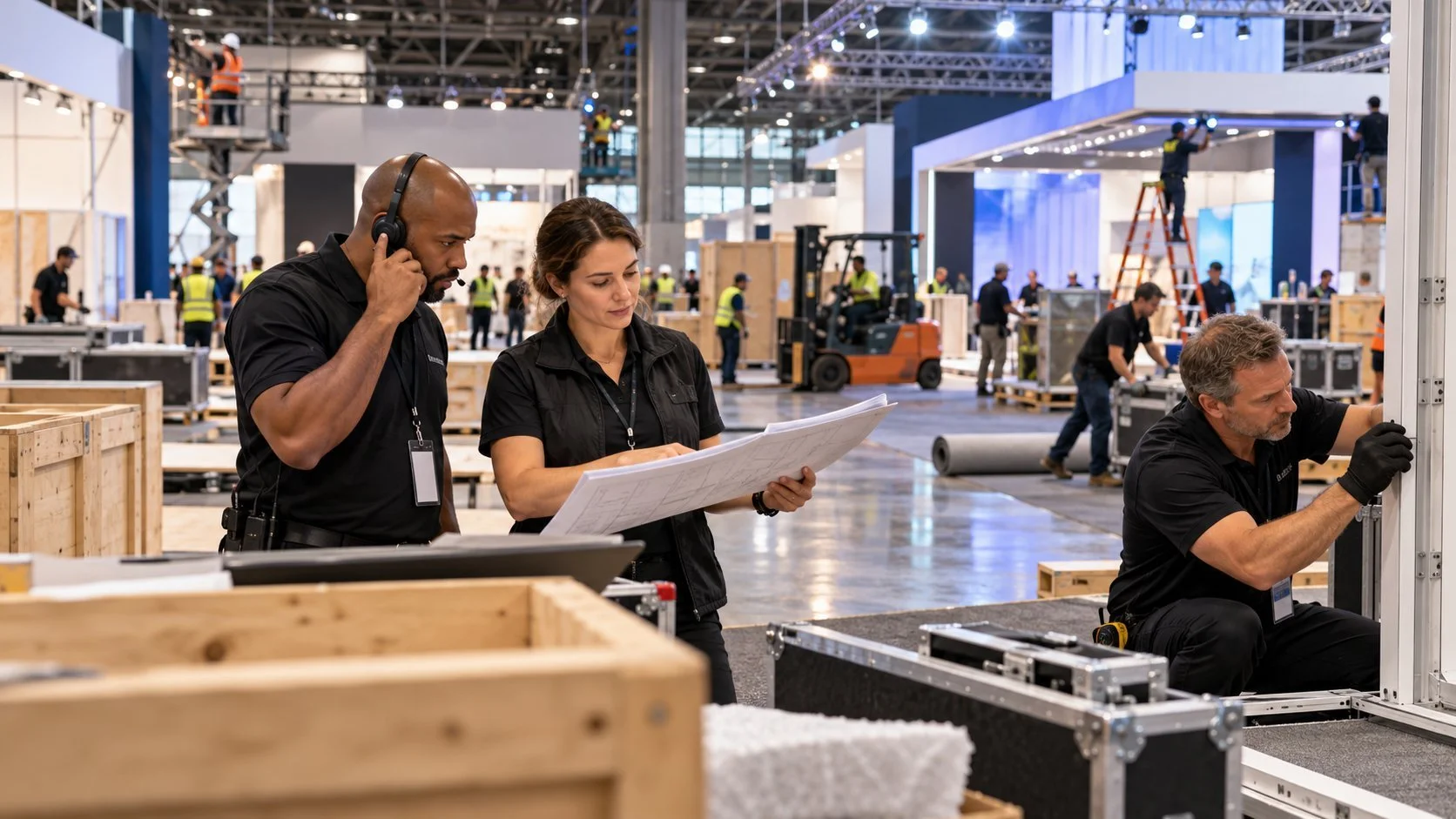
Situations like this occur more often than many exhibitors realize. Anyone who has spent time on a trade show floor during installation knows how chaotic those few days can be. Forklifts are moving in every direction. Hundreds of workers are unloading freight, laying carpet, installing exhibits, hanging signs, running electrical service, and preparing for opening day.
Something as simple as a roll of carpet being delivered to the wrong booth can create a significant delay. If flooring is not installed, the exhibit structure cannot be built. When that happens, experienced professionals begin troubleshooting immediately. Sometimes the missing flooring is found several aisles away. Sometimes it has been delivered to a neighboring booth. Sometimes another exhibitor notices it doesn't belong to them and reports it to the contractor. Problems like these require patience, persistence, relationships, and experience. They are solved every day by professionals working behind the scenes, often without the exhibitor ever knowing there was an issue.
As I was listening to the webinar discussion, I also thought about my friend and client Frank Supovitz and his excellent book, What to Do When Things Go Wrong. Frank has spent years managing some of the world's largest and most visible sporting events, including the Super Bowl. The book is less about preventing every possible problem and more about preparation, leadership, communication, and maintaining composure when the unexpected occurs. The Super Bowl blackout in New Orleans remains a perfect example. Millions of people were watching. The lights went out. In that moment, nobody was interested in determining fault. The priority was solving the problem, communicating clearly, and moving the event forward. Success came not from avoiding the crisis but from managing it effectively.
I learned a similar lesson during the aftermath of September 11, an experience that was later featured in Exhibitor Magazine's "Plan B" series. Those circumstances were unlike anything our industry had ever faced. There was no perfect contingency plan sitting on a shelf waiting to be implemented. What made a difference was having experienced professionals, trusted partners, strong relationships, and the ability to adapt as events unfolded. That, ultimately, is what clients are really investing in when they select an event partner.
During the webinar, Barb Campbell shared a quote from her mentor, Shannon Gardner, that perfectly reinforces this idea: "If you don't vet the cheapest option, you're not saving money, you're buying regret." The more I thought about that quote, the more it resonated. Too often vendors are evaluated primarily on price. Yet when challenges arise, the qualities that truly matter are experience, preparation, relationships, responsiveness, and the ability to remain calm under pressure.
In fact, after hearing some of the stories shared during the webinar, I found myself thinking that perhaps Shannon Gardner should write a book. Of course, Frank Supovitz already has, and it remains one of the best resources available for understanding crisis management in our industry. But there are countless stories throughout the events world that deserve to be documented because they contain lessons that can't be learned from a traditional college textbook.
Those lessons are also why efforts such as the Events Education & Workforce Development Federation's Invisible Industry Tour are so important. As their 45-foot trailer visits college campuses around the country, one of the goals is to help students understand what the events industry really looks like. It's not just floor plans, schedules, and registration systems. It's teamwork, adaptability, problem-solving, creativity, and resilience.
The stories shared during Dahlia's webinar reminded me that the best event professionals are not the ones who somehow avoid every challenge. They are the professionals who prepare thoroughly, anticipate risks, and then respond effectively when something unexpected occurs. Because despite our best planning, things will sometimes go wrong. When they do, clients are not looking for excuses. They are looking for solutions. And that is where the real value of an event partner becomes clear.
Thank you very much for taking the time to review my article. I invite you to explore our Case Studies and of course reach out if you have any questions, requirements or ideas to share.